IDD care management SaaS · Frontend performance
CoreHealth: Corenote
Led frontend for Corenote, an all-in-one care management platform for providers of services to people with intellectual and developmental disabilities (IDD): charting, medication administration, behaviour tracking, scheduling and billing. Core Web Vitals improved by more than 40% across 2,500 daily active users.
- role
- Frontend Team Lead (Software Engineer)
- organisation
- CoreHealth
- period
- Jan 2024 – Apr 2025
- 40%+
Core Web Vitals improvement
source: CV, CoreHealth
- 2,500
daily active users: clinicians, auditors and patients
source: CV, CoreHealth
The problem
Agencies that support people with intellectual and developmental disabilities run on documentation. Every service delivered has to be recorded in a way that satisfies state and accreditation standards (Corenote cites Georgia's DBHDD and DCH and CQL accreditation), medications have to be given and logged safely, and staff time has to reconcile with payroll and billing. Done on separate tools, that is slow for the people doing it and risky for the agency. The frontend therefore has to be fast on data-heavy screens and strict about the data it accepts.
What I built
I led the frontend team for the platform, and there is no module of it I did not work on. Corenote's public description covers person-centered charting and individual support plans, an electronic medication administration record (eMAR) with QR-code scanning at the point of care, health charting and incident reporting, behaviour support with built-in graphing, site-based scheduling with GPS-verified clock-in and clock-out, HIPAA-compliant messaging, billing and claims reconciliation, and HR and quality-assurance tools.
I improved Core Web Vitals by more than 40% with code-splitting, lazy loading and a clean-up of how state is managed, for clinicians, auditors and the people they support.
We built a reusable component system for the data-heavy screens, plus PDF, Excel and QR export tooling, and I hardened data validation across high-volume clinical records.
I worked with backend and product in agile sprints to design, estimate and ship new features.
Measure. Start from Core Web Vitals on real screens.
Diagrams are simplified from the work described above. Node colours: model, code, external service, person or result.
Screens
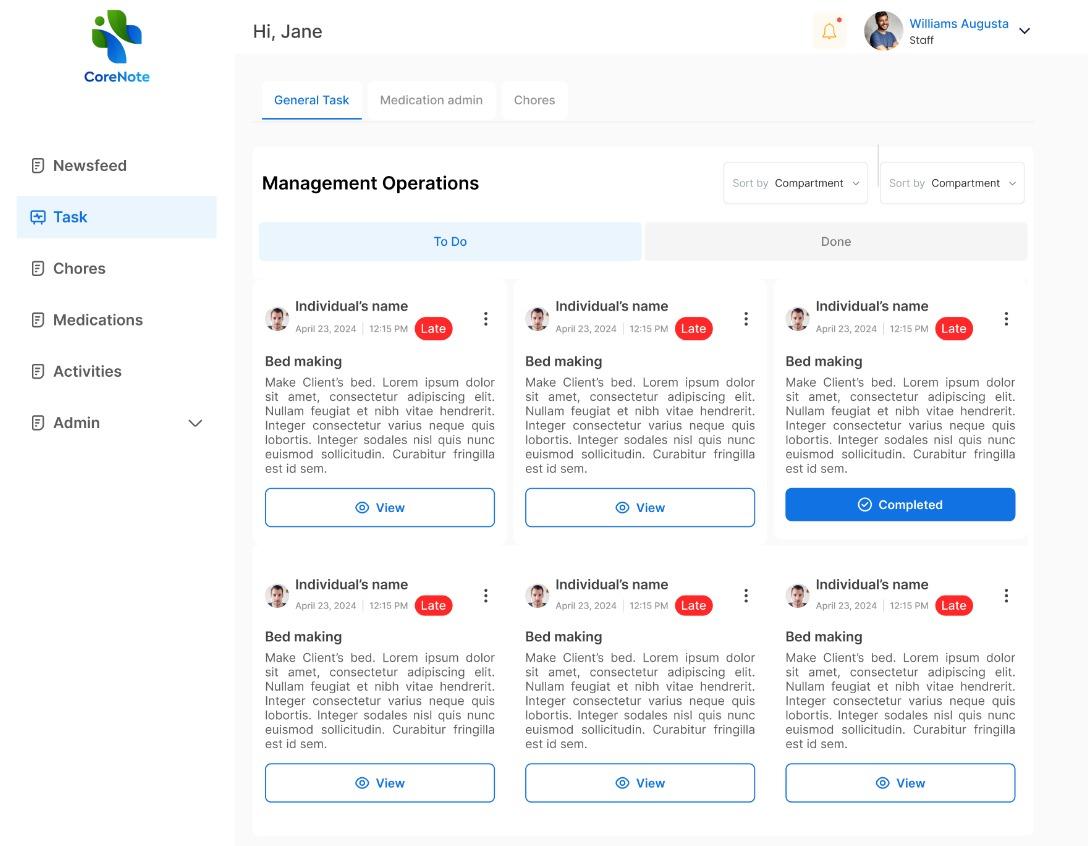
Staff task dashboard (design)The staff task dashboard design: a sidebar (Newsfeed, Task, Chores, Medications, Activities, Admin), tabs for general tasks, medication administration and chores, and task cards per individual with late and completed states (sample text). 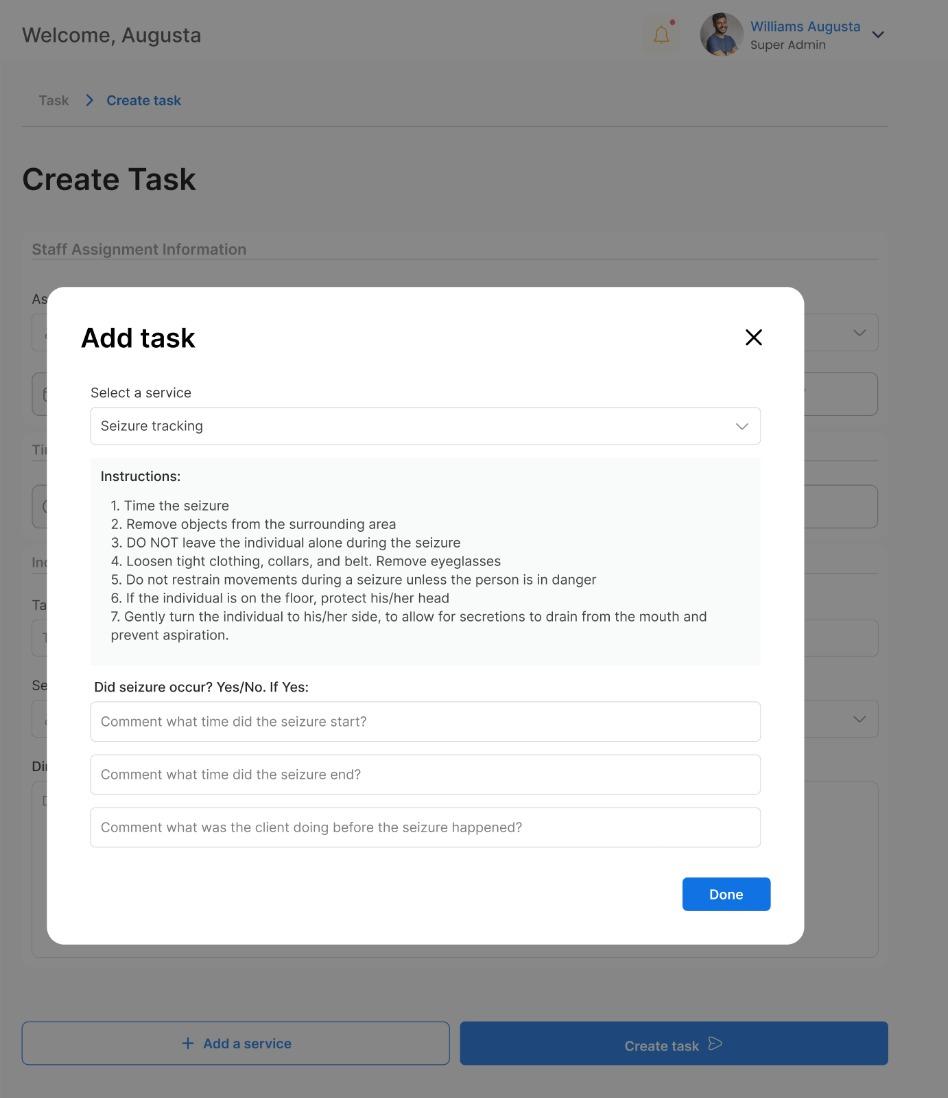
Add task: seizure tracking (design)Adding a task from a service template: seizure tracking, with the response instructions shown to staff and comment fields for the time a seizure started and ended and what the individual was doing before.
Engineering decisions
- 01
Treat Core Web Vitals as the target
The work was steered by Core Web Vitals, a user-centred measure, rather than by bundle size alone.
- 02
Load what the screen needs
Code-splitting and lazy loading move code and heavy UI out of the first load, and state clean-up removes work the screen did not need to do.
- 03
Components for data-heavy screens
Reusable table, export and validation components made the next data screen cheaper and more consistent than the last.
- 04
Validate clinical data at the edge
In a records system, a bad entry is a compliance problem. Validation runs where data is entered, not only where it is stored.
Stack
- Frontend
- React
- TypeScript
- Component system
- Performance
- Code-splitting
- Lazy loading
- State clean-up
- Core Web Vitals
- Data tooling
- PDF export
- Excel export
- QR codes
- Validation
next case study
Web3Bridge